AEX-740-98
Karen M. Mancl
Professor of Food, Agricultural and Biological Engineering
Extension Specialist, Water Quality
The most common wastewater treatment system
used in rural areas is the septic tank-soil absorption system. The septic
tank removes settleable and floatable solids from the wastewater, and the
soil absorption field filters and treats the clarified septic tank effluent.
Removing the solids from the wastewater protects the soil absorption system
from clogging and premature failure. In addition to removing solids, the
septic tank also permits digestion of a portion of the solids and stores
the undigested portion.
The septic tank removes solids by holding
wastewater in the tank, which allows the solids to settle and scum to rise
to the top. To accomplish this, wastewater should be held in the tank for
at least 24 hours. Up to 50 percent of the solids retained in the tank decompose.
The remaining solids accumulate in the tank. Biological and chemical
additives are not needed to aid or accelerate decomposition.
As the septic system is used, sludge continues
to accumulate in the bottom of the septic tank. Properly designed tanks
have enough space for up to three years safe accumulation of sludge. When
the sludge level increases beyond this point, sewage has less time to settle
properly before leaving the tank. As the sludge level increases, more solids
escape into the absorption area. If sludge accumulates too long, no settling
occurs before the sewage escapes directly to the soil absorption area. To
prevent this, the tank must be pumped periodically. The material pumped
out of the tank is known as "septage."
The frequency of pumping depends on several
factors:
(1) Capacity of septic tank.
(2) Flow of wastewater (related to size of household).
(3) Volume of solids in wastewater (more solids if garbage disposal is used).
Table 1 gives the estimated pumping frequencies
according to septic tank capacity and household size. The frequencies were
calculated to provide a minimum of 24 hours of wastewater retention assuming
50 percent digestion of the retained solids.
In Ohio, a 1500-gallon septic tank is used
for a home with three bedrooms. If six people reside in a three-bedroom
house, the tank should be pumped every 2.6 years. If the same system serves
a family of two, the tank would be ready for pumping every 9.1 years. Systems
installed before the current rules and regulations may have smaller septic
tanks. As shown in Table 1, these tanks may need to be pumped more often
than once a year.
| Table 1. Estimate Septic
Tank Pumping Frequencies in Years (For Year-Round Residence) |
| Tank Size (gal) |
Household Size (Number
of People) |
| 1 |
2 |
3 |
4 |
5 |
6 |
7 |
8 |
9 |
10 |
| 500 |
5.8 |
2.6 |
1.5 |
1.0 |
0.7 |
0.4 |
0.3 |
0.2 |
0.1 |
--- |
| 750 |
9.1 |
4.2 |
2.6 |
1.8 |
1.3 |
1.0 |
0.7 |
0.6 |
0.4 |
0.3 |
| 1000 |
12.4 |
5.9 |
3.7 |
2.6 |
2.0 |
1.5 |
1.2 |
1.0 |
0.8 |
0.7 |
| 1250 |
15.6 |
7.5 |
4.8 |
3.4 |
2.6 |
2.0 |
1.7 |
1.4 |
1.2 |
1.0 |
| 1500 |
18.9 |
9.1 |
5.9 |
4.2 |
3.3 |
2.6 |
2.1 |
1.8 |
1.5 |
1.3 |
| 1750 |
22.1 |
10.7 |
6.9 |
5.0 |
3.9 |
3.1 |
2.6 |
2.2 |
1.9 |
1.6 |
| 2000 |
25.4 |
12.4 |
8.0 |
5.9 |
4.5 |
3.7 |
3.1 |
2.6 |
2.2 |
2.0 |
| 2250 |
28.6 |
14.0 |
9.1 |
6.7 |
5.2 |
4.2 |
3.5 |
3.0 |
2.6 |
2.3 |
| 2500 |
31.9 |
15.6 |
10.2 |
7.5 |
5.9 |
4.8 |
4.0 |
4.0 |
3.0 |
2.6 |
| Note: More frequent pumping
needed if garbage disposal is used. |
It is important to note that the soil absorption field will not fail immediately
when a full tank is not pumped. However, the septic tank is no longer protecting
the soil absorption field from solids. Continued neglect will result in failure
and the soil absorption field may need to be replaced. In some cases, replacement
of the absorption area may not be possible due to site limitations.
Cleaning the Tank
Septic tank pump and haul contractors can
clean your tank. It is a good idea to supervise cleaning to ensure that
it is done properly. To extract all the material from the tank, the scum
layer must be broken up and the sludge layers stirred up into a liquid portion
of the tank (see Figure 1). This is usually done by alternately siphoning
liquid from the tank and reinjecting it into the bottom of the tank. The
septic tank should be pumped out through the large central manhole, not
the baffle inspection ports. Pumping out a tank through the baffle inspection
ports can damage the baffles.
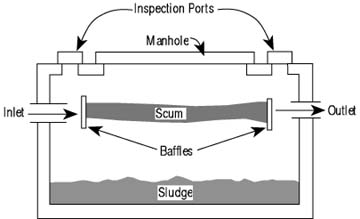
Figure 1. Cross section of a septic tank.
Before closing the tank, check the condition
of the baffles. If they are missing or deteriorated, replace them with sanitary
tees. It should never be necessary to enter a septic tank.
Any work to replace the baffles or repair the tank should be made from the
outside. The septic tank produces toxic gases that can kill a person in
a matter of minutes. When working on a tank, make sure it is well ventilated
and someone is standing nearby. Never go into a septic tank to retrieve
someone who fell in and was overcome by toxic gases or the lack of oxygen
without a self-contained breathing apparatus (SCBA). If a SCBA is not available
the best thing to do is call for emergency services and put a fan at the
top of the tank to blow in fresh air.
To facilitate future cleaning and inspection,
install risers from the central manhole and inspection ports to the surface
or near the surface before burying the tank. Also mark the location of the
tank so that it can be easily found.
Summary
The septic tank is only one part of an on-site
wastewater system. It is designed to remove solids to protect the soil absorption
system, provide for the digestion of a portion of those solids and store
the remaining solids. Biological and chemical additives are not needed to
aid or accelerate decomposition. Garbage disposals are also not recommended,
because they impose an additional solids load on the system. Solids must
be removed periodically from the septic tank to keep them from entering
the soil absorption system. For a properly designed septic system, the tank
should be inspected and pumped every one to five years.


